
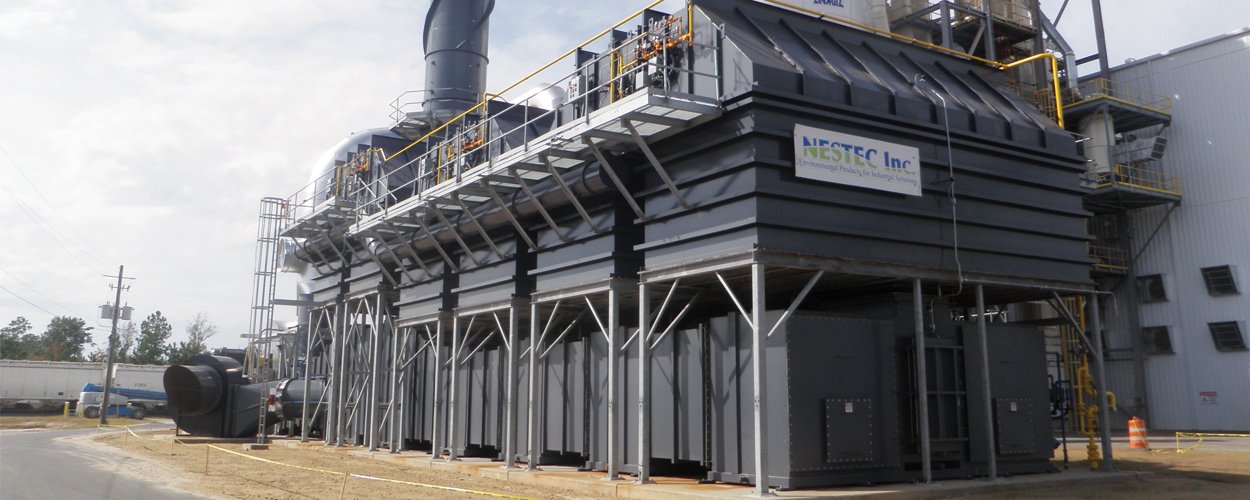
A Title V permit violation isn’t the kind of problem a plant manager can sit on. For Georgia Biomass, a plant that ranks among the largest wood pellet producers in North America, an EPA violation tied to air emissions came with a fine, a fixed regulatory deadline, and the real possibility of having to throttle back production. Its facility based in Waycross, Georgia, later acquired by Enviva, needed to get back under its permit limits quickly, and it needed a fix that would hold for years, not one that barely cleared the next stack test.
That combination of high stakes and a short fuse is exactly where most generic compliance solutions fall apart. Georgia Biomass brought the problem to NESTEC, and the project that followed resolved the violation so effectively that it became a reference point for how the wood biomass industry controls emissions.
Pellet Pollution Problems
Wood pellet manufacturing looks clean on paper because it turns wood residuals into a renewable fuel, but the process generates real air emissions. Grinding raw material in hammer mills and cooling finished pellets both release volatile organic compounds (VOCs) and hazardous air pollutants (HAPs). At a plant the size of Waycross, those emission streams are large and continuous, and a federal Title V operating permit puts hard limits on what can go up the stack.
Georgia Biomass had two major emission sources to deal with: primary and secondary grinding lines running ten hammer mills each, and five pellet cooling lines tied to a total of 22 pellet mills. To bring both back into compliance, NESTEC had to design control equipment matched to the actual airflow and pollutant load of each. Merely bolting a one-size-fits-all oxidizer onto the end of the process would have resulted in higher fuel costs, weaker destruction efficiency, and a real risk of clearing one stack test only to drift back out of compliance the next time production swung.
The Engineered Solution: Purpose-sized RCOs
NESTEC engineered and installed two multi-chamber Regenerative Catalytic Oxidizers (RCOs), one rated at 100,000 SCFM for the hammer mill lines and one at 150,000 SCFM for the pellet mill and cooler lines. An RCO works by drawing the contaminated air stream through a heated chamber where a catalyst drives oxidation of the VOCs and HAPs, converting them into far less harmful compounds before the air is released. The regenerative part is what makes it economical: ceramic media captures heat from the cleaned exhaust and reuses it to preheat incoming air, so the system isn’t constantly burning fuel to stay hot.
The more interesting engineering decision was the catalyst itself. NESTEC specified a non-precious-metal, base-metal manganese oxide catalyst at a time when precious-metal catalysts were the industry default. The base-metal media required a somewhat higher activation temperature (around 750°F), but the trade-off worked in the plant’s favor. Because the air stream coming off the process was rich in VOCs, those compounds carried enough fuel value to keep the reaction self-sustaining. The system held its operating temperature without burning meaningful amounts of additional natural gas. That choice traded a small thermal penalty for a large cut in catalyst cost and fuel consumption, and it landed years before base-metal catalysts became common practice across the sector.
NESTEC didn’t stop at the oxidizers. While the equipment was going in, the team reworked the facility’s ducting to push more airflow to the pellet coolers. That modification improved cooler efficiency and, as a direct result, lifted production capacity. The plant came out of the project not just compliant but running better than before.
Tight Spaces and Deadlines
Several constraints made this project harder than a typical oxidizer installation. First, the existing layout inside the plant buildings and grounds was extremely tight. There was no room for off-the-shelf equipment dropped into open floor space, so the systems had to be precisely measured and custom-fabricated to fit around what was already there, without interrupting production.
The second big concern was the schedule. The Environmental Protection Division (EPD) of the Georgia Department of Natural Resources had set a January deadline to have the equipment in place. NESTEC committed to a six-month installation window and completed field acceptance testing in October 2013, well ahead of the regulatory date. For a plant under an active violation, hitting that timeline was the entire point.
As in any major industrial operation, safety was also a top concern. Pellet plants accumulate combustible wood dust, and the construction work was happening inside active production areas classified as explosion risks. NESTEC met the plant’s stringent construction safety requirements throughout, using equipment and procedures built for that environment.
Guarantees Met, Then Exceeded
When a contract spells out performance guarantees, the honest measure of a project is what the acceptance tests show. On the Georgia Biomass systems, NESTEC met its contractual commitments and exceeded most of them by a wide margin.
On airflow, both oxidizers ran well above their rated capacities. The hammer mill RCO tested at roughly 116,700 DSCFM against a 100,000 contract figure, and the pellet mill RCO at about 181,200 DSCFM against 150,000. The auxiliary pellet cooler ID fan also cleared its target.
On the measures that actually determine compliance, the results were the story. VOC destruction efficiency was guaranteed at greater than 95%; the hammer mill unit hit 97.2% and the pellet mill unit 95.2%. Combined VOC emissions were capped at under 100 short tons per year, and the tested total came in at 50.3 — roughly half the limit, which is the kind of headroom that keeps a plant safely inside its permit through normal operating swings.
Efficiency told the same story. Thermal efficiency landed at or above the guaranteed 95% once corrected for mass flow, confirming the regenerative heat recovery was doing its job. Natural gas consumption was guaranteed under 6 MMBtu/hr and tested at just 1.4. Electricity use was guaranteed under 1,369 kW and came in at 773.5. System availability was guaranteed above 96% and measured at 99.1%.
Read together, those numbers describe a system that controls emissions extremely well while costing very little to run, which is exactly the balance a plant wants when it’s living under a federal permit for the next decade.
Forward-thinking Engineering Pays Off
Georgia Biomass got what it needed: full compliance with its EPA Title V limits, the violation resolved, and a control system efficient enough that the energy and fuel savings offset its operating burden. The sustainability case followed naturally thanks to lower VOC and HAP emissions, cleaner production, and a smaller environmental footprint for a renewable-fuel producer.
For NESTEC, the project became a proving ground. The base-metal catalyst approach, the integrated ducting work, and the ability to deliver under a regulatory clock in a hazardous, space-constrained plant added up to a template the company has since brought to most of the major producers in the wood biomass sector.
There are a few takeaways worth carrying into any similar situation. Equipment engineered to a plant’s actual emission sources outperforms a generic compliance fix, and it tends to pay for itself in fuel and uptime. Acting early, before a violation hardens into shutdowns and escalating fines, gives engineers room to design the right solution instead of the fastest one. And the best emissions projects do more than satisfy a regulator. They also leave the process running better than they found it.
If your facility is facing a permit challenge, a looming deadline, or aging control equipment that’s getting harder to keep compliant, that’s the conversation NESTEC is built for.
Reach out to talk through your emission sources and what a right-sized solution would look like.